Renewal of the Mind is a Fairfax, VA psychotherapy practice serving individuals, couples, families, children, teens, and adults across Northern Virginia. Our team provides supportive, culturally aware, and personalized care designed around each client’s unique needs.

Research suggests that online couples therapy can be as effective as in-person therapy for improving relationship and sexual satisfaction. Although the therapeutic connection may develop differently for each couple. One study found comparable overall outcomes, while a review described videoconferencing as feasible, acceptable, and effective for couple and family therapy.
For most couples, online couples therapy can be as effective as in-person therapy for improving relationship satisfaction. Research comparing teletherapy with face-to-face treatment found similar improvements in couple satisfaction and sexual satisfaction. A review of videoconferencing psychotherapy also found it to be a feasible, acceptable, and effective way to provide couple and family therapy. These findings suggest that the quality of the therapeutic relationship, the therapist's training. And each partner's willingness to participate matter more than whether the session takes place in an office or through a secure video platform.
A 2022 study in Frontiers in Psychology adds support for using videoconferencing in couple therapy, including its potential to deliver meaningful treatment while reducing practical barriers such as commuting and coordinating schedules. You can review the study's methods and findings in Frontiers in Psychology. Related research is also indexed in PubMed and a systematic review of videoconferencing for couple and family therapy is available through PubMed.
Online sessions give couples the opportunity to practice honest communication in a familiar setting. Partners may be more likely to attend consistently when they do not need to arrange transportation, take as much time away from work, or travel across Northern Virginia. A therapist can help partners identify recurring conflict patterns, listen to each person's concerns, and build practical skills for responding to difficult conversations. The work still requires openness, preparation, and effort from both people. A video visit is a treatment format, not a shortcut around the relationship work itself.
There is one important difference to consider. In one study, the therapeutic alliance improved at about twice the rate in in-person therapy as in teletherapy. The alliance refers to the collaborative relationship between the couple and therapist. This finding does not mean that virtual therapy is ineffective. It suggests that some couples may need a little more time and intentional communication to develop trust and comfort through a screen. Discussing preferences, technical concerns, and expectations early can help strengthen that connection.
Online couples therapy may be a good fit when both partners can attend from private locations, use a reliable internet connection, and feel comfortable speaking openly by video. If safety concerns, severe conflict, or difficulty maintaining privacy make a virtual setting unsuitable, a therapist can help you consider in-person care or another appropriate option. A professional consultation can help determine which format best supports your circumstances.
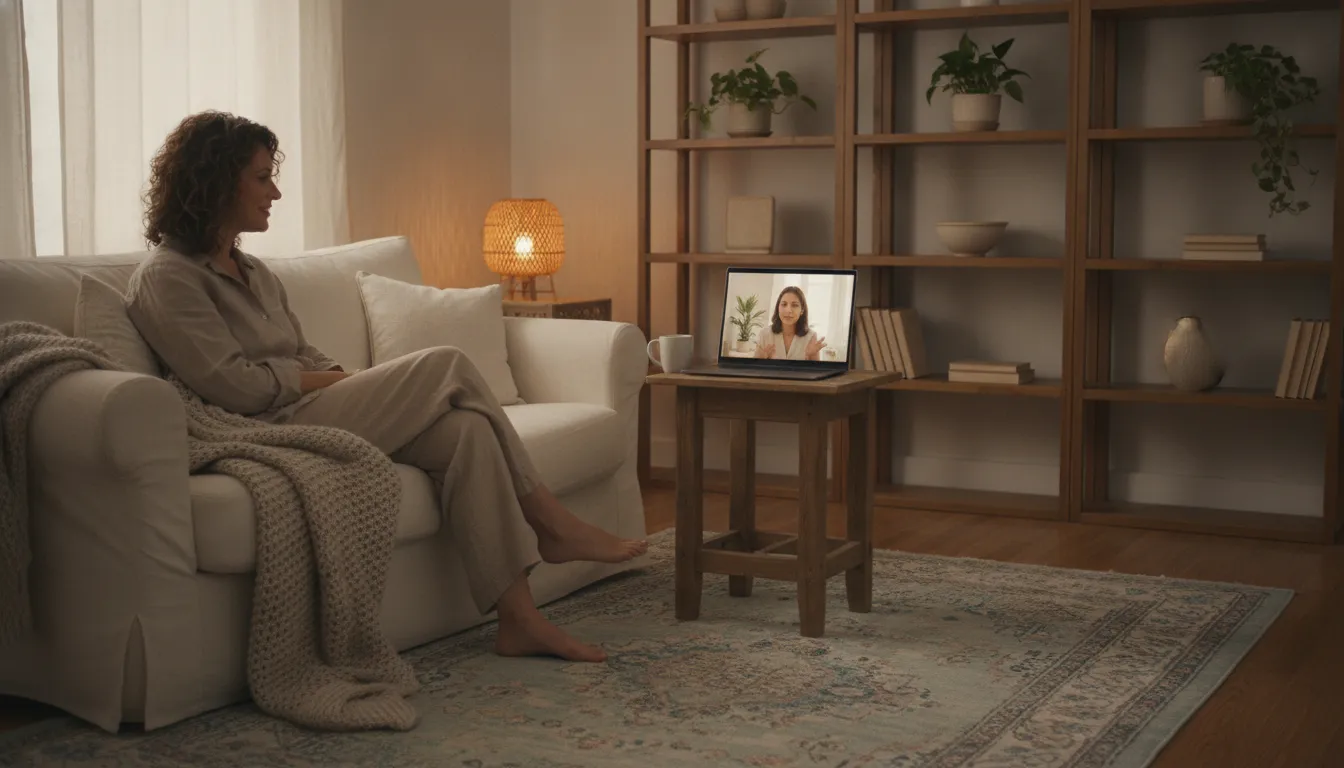
Online couples therapy follows a structured process, but it does not require both partners to travel to the same office for every appointment. Couples can meet with a licensed therapist through a secure, HIPAA-compliant video platform from a private location. This makes virtual care a practical option for partners managing work, parenting, commuting, or different schedules across Fairfax, Northern Virginia, and other parts of Virginia.
The goal is still meaningful conversation and collaborative relationship work. The therapist guides the discussion, notices communication patterns and nonverbal cues visible on screen, and helps both partners identify goals that fit their circumstances. A typical session lasts 50 to 60 minutes. The process generally looks like this:
Telehealth is available throughout Virginia, including for couples in Fairfax and the wider Northern Virginia region. If you are unsure whether virtual sessions fit your relationship or situation, a professional consultation can help you make an informed decision.
Call (571) 264-8192 to schedule your online couples therapy session
Yes. When it is provided by a qualified mental health practice, online couples therapy can be delivered through a HIPAA-compliant. Encrypted video platform designed to protect the confidentiality of your sessions. Couples can discuss communication concerns, conflict, trust, and other sensitive relationship matters without those conversations taking place in a public setting. Renewal of the Mind offers HIPAA-compliant telehealth alongside in-person care for couples across Northern Virginia and Virginia.
HIPAA compliance refers to privacy and security requirements for protected health information. In practical terms, the practice should use a secure telehealth system, limit access to patient information, and follow policies for handling clinical records and communications. Encrypted data transmissions help reduce the risk that unauthorized people will intercept information while it moves between devices. The practice does not record sessions as a routine part of online couples therapy, and couples should ask about any recording policy before beginning care.
The American Psychological Association explains that telehealth and telepsychology should be provided in ways that protect client privacy, support informed consent, and follow professional and ethical standards. You can review its guidance on telehealth and telepsychology for more information. A secure platform is important, but privacy also depends on the environment where each partner joins the session.
Privacy needs can be different for each couple. One partner may have a quiet home office, while the other may need to arrange a separate room or another private location. Tell your therapist if either person cannot speak freely. The therapist can help you consider practical alternatives, including scheduling at a different time or discussing whether an in-person appointment would feel safer.
Online sessions are intended to provide a safe, confidential space, but no communication method can eliminate every privacy risk. During an initial consultation, ask how the platform works, what information is stored, and how emergencies are handled. This article is for general information and is not a substitute for professional advice. A licensed therapist can help you decide whether virtual or in-person care is the better fit for your relationship and circumstances.
Both formats can support meaningful relationship work. Psychotherapy gives partners a structured setting to understand patterns, build healthy coping skills, and practice more constructive ways to communicate and resolve conflict. The best choice depends less on a universal ranking and more on what allows both partners to participate openly and consistently. Research suggests that teletherapy can be as effective as in-person therapy for improving relationship outcomes, although the therapeutic alliance may develop differently online. A study indexed by PubMed found broadly comparable results between the two formats.
| Consideration | Online couples therapy | In-person counseling |
|---|---|---|
| Convenience and flexibility | Partners can connect from a private home setting, avoiding much of the commute and making care more accessible for busy couples. | Partners travel to the same office, which may feel more separate from home responsibilities and daily interruptions. |
| Privacy setup | Sessions use a secure telehealth platform, but each partner must arrange a quiet, private location where sensitive conversations cannot be overheard. | The practice provides the controlled therapy-room environment. Privacy at home or during travel is less of a factor during the session. |
| Therapeutic alliance | A strong connection can develop through video, but the alliance may build at a different pace when the therapist and partners are not sharing a physical room. | In-person contact may help some couples feel connected more quickly. The therapist can still help partners build trust and work toward shared goals in either format. |
| Scheduling | Virtual access can make it easier for both partners to attend consistently, including when work, caregiving, distance, or traffic complicates coordination. | Appointment times must account for travel and the office location, which may narrow the practical options for two busy schedules. |
| Access to therapists | Telehealth can expand the available network, increasing the chance of finding a licensed therapist who matches the couple's needs, language, and availability. | Care is limited to therapists and appointment times that are practical for the couple to reach in person. |
| Insurance coverage | Some plans cover virtual counseling, but coverage for couples therapy varies by plan. Confirm benefits, copays, and any telehealth requirements before starting. | Coverage also varies by plan. Ask whether the therapist is in network and how your plan classifies couples counseling. |
For some couples, online care removes the barrier that would otherwise lead to missed sessions. For others, being in the same room helps them focus, feel grounded, or engage more comfortably with the therapist. Neither preference is a sign that one partner is taking therapy more seriously. The practical goal is a format that supports honest participation, emotional safety, and continuity. A clinician can help you consider the relationship concerns, privacy needs, location, and scheduling realities involved before you choose.
Call (571) 264-8192 to talk about which format fits your relationshipThe right therapist can make online couples therapy feel focused, private, and relevant to your relationship. Start by confirming that the provider is licensed to practice in Virginia and has experience working with couples. Licensed professionals may include counselors with LPC credentials or marriage and family therapists, depending on the provider's training and scope of practice. Ask how the therapist approaches communication patterns, conflict, trust concerns, or other issues you and your partner want to address.
Ask whether sessions take place through a secure, HIPAA-compliant video platform and how the practice protects your information. You should also know how long appointments last, what happens if the connection fails, and whether both partners can join from separate locations when needed. At Renewal of the Mind, couples typically attend 50- to 60-minute sessions through a hybrid model that can include both virtual and in-person care. Before each appointment, choose a private, quiet space where both partners can speak openly without interruptions.
You can learn more about online therapy services in Virginia, including how telehealth can support clients across the state. A practical advantage of virtual care is that it may make consistent attendance easier for couples managing work, parenting, commuting, or different schedules. Convenience should support the therapeutic relationship, not replace a thoughtful assessment of fit.
Insurance coverage for couples therapy varies by plan, so confirm benefits, copays, deductibles, and any limits directly with your insurer and the practice. Renewal of the Mind is in network with more than 13 carriers, including Cigna, Aetna, Blue Cross Blue Shield, UnitedHealthcare, Kaiser, and Medicaid. Participation and coverage can differ by plan, service, and clinician, so verification before the first session is important.
Language and cultural understanding may also shape how comfortable and useful therapy feels. Renewal of the Mind offers multilingual services in Arabic, Spanish, Korean, German, and Malayalam. For immigrant couples, ask whether the therapist understands cultural adjustment, family expectations, and the relationship stress that can accompany immigration experiences. If trauma is part of your shared history, ask about trauma-informed care and whether virtual EMDR is appropriate for your situation. A clinician can explain available options and help you decide what fits your goals.
For more guidance on local care, explore couples counseling in Northern Virginia. This information is educational and not a substitute for professional advice. A consultation can help you evaluate whether a therapist's training, approach, availability, and services are a good match for both partners.
There is no single moment that determines whether a couple should seek support. Online couples therapy may be a useful option when conversations repeatedly turn into arguments, important concerns remain unresolved, or both partners want guidance before distance grows. Seeking help early can give couples more room to understand patterns and practice healthier ways to respond. Although each relationship is different and a qualified professional can help you decide what kind of care fits your situation.
Consider reaching out if you notice one or more of these situations:
Online care is not appropriate for every circumstance, particularly when either partner cannot participate safely or privately. Discuss your needs with a licensed couples therapist who can help you evaluate the best format and next step. This information is educational and is not a substitute for professional advice.
Call (571) 264-8192 to talk with a licensed couples therapist about online sessions.
Research suggests that teletherapy can be as effective as in-person therapy for improving relationship and sexual satisfaction. Although couples may experience differences in how quickly the therapeutic relationship develops. Videoconferencing is also considered a feasible and acceptable format for couple and family therapy. Research published in PubMed supports discussing the format with a licensed therapist based on your goals and comfort.
Coverage varies by insurance plan, the services provided, and how the visit is billed. Before scheduling, ask your insurer whether couples counseling or telehealth sessions are covered, what your copay or deductible may be, and whether your plan requires an in-network clinician. Our team can help you understand the next steps, but your insurance plan determines your final benefits.
Virtual counseling should take place through a secure, HIPAA-compliant telehealth platform, with each partner joining from a private location. Renewal of the Mind offers HIPAA-compliant telehealth services, and the American Psychological Association's telehealth guidance provides additional information about privacy and informed participation. Couples should use headphones when appropriate and avoid public spaces for sensitive conversations.
It may be a practical option when partners cannot easily reach the same office or need more scheduling flexibility. Couples can join from separate private locations, as long as the therapist is permitted to provide care where each person is located. Ask the practice about state-licensure requirements, session timing, and whether both partners can reliably access a private, stable internet connection.
Online couples therapy can offer a private, flexible setting to work with a licensed therapist on communication, connection, and shared goals. Our team can help you understand whether virtual counseling fits your relationship, schedule, and preferences. For informational purposes only, this article is not a substitute for professional advice. Discuss your circumstances with a qualified mental health professional.
Call (571) 264-8192 to schedule an online couples therapy session.
Our compassionate team at Renewal of the Mind is here to help — whether you’re navigating anxiety, trauma, relationship challenges, or simply need someone to talk to. We offer in-person and telehealth sessions across Northern Virginia.