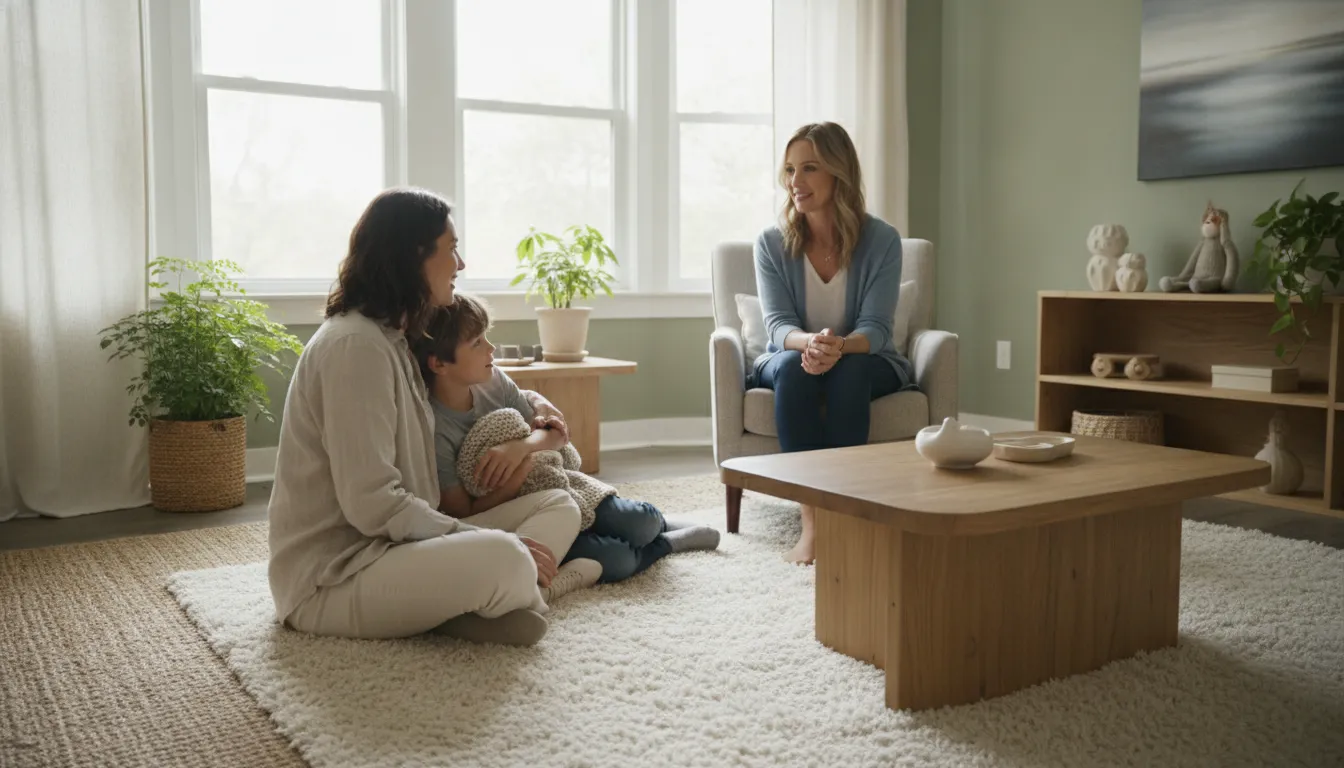
Renewal of the Mind is a Fairfax, VA psychotherapy practice serving individuals, couples, families, children, teens, and adults across Northern Virginia. Our team provides supportive, culturally aware, and personalized care designed around each client’s unique needs.

When a child's behavior repeatedly disrupts home, school, or relationships, parents may feel worried, exhausted, or unsure what to try next. These challenges do not mean a child is bad or that a parent has failed. They may signal that a child needs help learning new skills and that the family could benefit from practical guidance.
Call (571) 264-8192 to discuss behavioral therapy support for your child.
Behavioral therapy for kids is a structured, individualized approach that identifies practical goals and teaches children and caregivers strategies for strengthening helpful behaviors, navigating daily challenges, and improving family interactions. It focuses on skill-building rather than labels, and progress often develops gradually.
This guide explains what the approach may involve, which techniques a clinician might use, when an evaluation could help, and how parents can choose a child therapist. It is educational information, not a diagnosis or a substitute for an individualized evaluation.
Behavioral therapy for kids is a structured approach that helps children and families understand behavior patterns and practice more useful responses. A therapist considers what happens before a behavior, what follows it, the child's developmental stage, and the environment around the child. The goal is to support well-being and daily functioning, not to define a child by a diagnosis.
The first phase often includes learning about the child's strengths, routines, relationships, school experience, communication style, and situations that feel difficult. The family and therapist then identify goals that fit the child's age and circumstances. A goal might be helping a preschooler move through bedtime with fewer reminders, helping a school-age child pause before reacting, or helping a teenager communicate frustration more safely.
Goals are specific and observable so families can recognize meaningful change. Depending on the child's needs, therapy may focus on:
Younger children may learn through play, movement, stories, and brief activities. Older children may talk through choices, consequences, coping skills, and problem-solving. Caregivers often learn how to make expectations clear, respond consistently, and notice small successes. The goal is not perfect behavior. It is steady progress toward skills that help a child participate in family, school, and community life.
Behavioral therapy is not a quick fix or a promise of a particular outcome. A qualified mental health professional can help determine whether this approach fits the child's needs. Family counseling, trauma-focused care, school support, or another service may also be considered. Renewal of the Mind offers child and family therapy in Fairfax and through HIPAA-compliant telehealth across Northern Virginia.
In behavioral therapy for children, the therapist usually begins by understanding everyday routines, strengths, stressors, and specific situations that are hard for the child or family. The clinician and caregivers then choose manageable goals, practice skills in developmentally appropriate ways, and review observations over time. Parent participation often helps connect session learning to daily life.
A first visit may include questions about home routines, school experiences, relationships, sleep, transitions, communication, and recent changes. Parents can bring examples of what happens before and after a challenging behavior. A child may share their perspective through conversation, play, drawing, or another activity suited to their age and comfort.
Therapy should not use a single plan for every child. A young child might practice turn-taking through a game, while an older child might rehearse a calm way to ask for help. The clinician may break a larger goal into smaller steps. Instead of expecting a child to complete an entire morning routine independently, the first step might be completing one part with one reminder.
Caregivers may learn to give concise directions, reinforce desired behavior, set predictable limits, and stay responsive when a child is upset. These strategies are meant to support learning, not punish a child. Parent coaching can be useful because caregivers can practice skills during meals, homework, transitions, and bedtime, where patterns naturally occur.
When appropriate and with the family's permission, a therapist may coordinate with school personnel. Compatible expectations across settings can reduce confusion for a child. Any communication should respect privacy, consent, and the family's choices. The amount of child, caregiver, and school participation depends on age, needs, goals, and circumstances.
The Centers for Disease Control and Prevention describes behavior therapy and parent training as approaches that can involve caregivers in supporting a child's behavior and skills.

Behavioral therapy techniques give children and caregivers practical ways to understand patterns, practice new responses, and make routines more manageable. A clinician selects and adapts techniques based on the child's age, communication style, strengths, needs, culture, and environment. The goal is skill-building, not fear, shame, or a demand for perfect behavior.
| Technique | How it may support learning |
|---|---|
| Positive reinforcement | Connects a desired behavior with timely, specific encouragement. |
| Modeling and shaping | Shows a skill and breaks a larger goal into manageable steps. |
| Behavior tracking | Helps families notice patterns and adjust strategies using observations. |
| Environmental structure | Makes expectations more predictable and reduces avoidable distractions. |
Positive reinforcement means responding soon after a desired behavior so the child can connect the action with encouragement. Instead of saying only "good job," a caregiver might say, "You put your shoes away when I asked. That helped us get ready." Praise, attention, a preferred activity, or another age-appropriate reward may be used. A therapist can help a family choose reinforcement that is meaningful without making every routine dependent on a prize.
Children often respond more easily to one concise direction than to a long list. It can help to state what the child should do, use language they understand, and offer a calm reminder. Modeling lets children watch an adult ask for help, take turns, or use a coping skill. Shaping breaks a larger goal into smaller steps and recognizes progress toward the final skill.
Brief notes can help families notice when a behavior occurs, what came before it, and what followed. The purpose is not to monitor or judge a child. It is to give the therapist and family useful information. Visual routines, advance warnings, reduced distractions, planned transitions, and predictable expectations can also make a skill easier to use.
For some minor attention-seeking behaviors, a clinician may teach a caregiver to withdraw attention briefly while offering warm attention when the child uses a more appropriate behavior. This strategy is not appropriate for unsafe, harmful, or distress-related behavior. When safety is a concern, adults should respond promptly and seek professional guidance. Any consequence should be calm, predictable, respectful, and appropriate to the child's development.
CDC guidance on children's mental health treatment can help parents understand why treatment plans should be individualized. A therapist can also consider stress, trauma, sensory needs, learning differences, sleep, and family changes when adapting a plan.
Call (571) 264-8192 to discuss behavioral therapy support for your child.
Parents do not have to wait for a crisis, suspension, or formal diagnosis before asking for support. An evaluation may be useful when a child's behavior is persistent, creates difficulty in more than one setting, or is hard for caregivers to manage alone. The impact on daily life matters more than one challenging moment.
Families may consider professional guidance when frequent outbursts, intense frustration, impulsivity, refusal, aggression, or difficulty with routines interfere with home life, school participation, friendships, or sleep. These concerns do not automatically indicate a disorder. A clinician should consider development, temperament, stress, family changes, learning needs, physical health, and the child's environment.
School concerns can also prompt a conversation. A child may need help with transitions, staying on task, following classroom expectations, completing work, or maintaining friendships. With consent, a therapist may coordinate with school personnel so the child is not expected to navigate completely different responses at home and school. Treatment may include individual therapy, parent coaching, family counseling, or school-based support.
For children with ADHD-related concerns, behavior therapy can teach caregivers strategies for encouraging positive behavior and addressing difficult conduct. The CDC notes that parent training in behavior management is recommended as a first-line treatment for children younger than six with ADHD. For older children, families can discuss behavioral support alongside other options with a qualified healthcare professional. A diagnosis should come from an appropriate evaluation, not from one behavior or a blog post.
Children who show repeated defiance, angry interactions, or difficulty recovering after conflict may benefit from a closer look at the pattern. Therapy may address emotional regulation, social skills, communication, and the parent-child relationship. A child is not bad, and a parent has not failed. The purpose of care is to understand what is happening and practice safer, more effective skills.
Choosing a therapist can feel difficult when you are already concerned about your child's behavior. Look for a clinician who works with children and has experience with the concerns your family is facing. Evidence-informed care should be adapted to age, development, communication style, culture, and needs rather than applied as a one-size-fits-all program.
Ask whether the clinician offers in-person appointments, telehealth, or both. Telehealth may make parent coaching more accessible from home, while in-person care may be preferable for a child who engages more comfortably in an office. Renewal of the Mind serves families in Fairfax and across Northern Virginia through in-person care and HIPAA-compliant telehealth.

For younger children, child play therapy may offer a developmentally appropriate way to build trust and practice communication. If trauma is part of the picture, parents can learn more about trauma-focused cognitive behavioral therapy for children. Families may also explore online therapy options when virtual care fits the child's needs and the family's routine.
The right fit should feel collaborative, respectful, and specific to your child. No single approach is right for every family. A professional evaluation can help clarify whether behavioral therapy, trauma therapy, family counseling, play therapy, or another service best matches the concerns you are seeing. Families who want to review the practice's broader child and family therapy services can explore the available care options.
Behavioral therapy for kids can be one part of a broader plan. Depending on the child's needs, a clinician may discuss play therapy, trauma-focused care, family counseling, art therapy, school collaboration, or other supports. The goal is to match the service to the child's age, concerns, strengths, culture, and daily environment rather than assume that one approach fits everyone.
Play therapy may help younger children communicate through play when direct conversation feels difficult. Renewal of the Mind offers play therapy for children ages 3 to 12. For children or teens whose concerns relate to trauma, a clinician may discuss TF-CBT information for families and whether trauma-focused support is appropriate. Creative work can also give some children another way to express feelings, and families can learn more about art therapy in Fairfax.
Behavioral support does not replace an evaluation when a child has a sudden change in functioning, persistent distress, or a safety concern. A mental health professional can ask about development, family changes, school context, physical health, sleep, and stress before recommending next steps. With consent, coordination among caregivers, therapists, and school personnel may help adults use compatible expectations.
Renewal of the Mind provides child and family therapy in Fairfax and HIPAA-compliant telehealth across Northern Virginia. Families can also review the practice's contact information when they are ready to ask about fit, availability, and the type of support that may be appropriate.
Call (571) 264-8192 to discuss support for your child.
Parents are often active partners. A therapist may coach you to give clear directions, notice helpful behavior, respond calmly to difficult moments, and practice strategies between sessions. The amount of participation depends on the child's age, goals, and needs. School communication may also be considered with appropriate consent.
It may help when the plan examines what happens before and after an outburst, teaches the child ways to recognize and manage emotions, and gives caregivers practical responses. The goal is not to label a child as difficult or eliminate every strong feeling. A clinician should first consider development, environment, stress, and safety.
Telehealth may be useful when parent coaching is a central part of care and the child can participate meaningfully from home. A clinician can help determine whether virtual sessions fit the child's age, attention, privacy, technology access, and treatment goals. Some families prefer in-person care, while others benefit from a hybrid arrangement.
There is no universal timeline. Progress depends on the child's needs, goals, family participation, consistency, and the setting in which skills are practiced. Change may first appear as shorter conflicts, faster recovery, or success with one routine. Regular reviews help the family and clinician decide whether the plan should be adjusted.
If your child's behavior is affecting daily life, a conversation with a qualified clinician can help you understand possible next steps. Bring your questions, examples of challenging routines, and observations about your child's strengths. Renewal of the Mind provides child and family therapy in Fairfax and HIPAA-compliant telehealth across Northern Virginia.
Call (571) 264-8192 to discuss support for your child.
Healthcare disclaimer: This article is for general educational purposes and does not diagnose, treat, or replace individualized medical or mental health advice. If you have concerns about your child's behavior or safety, consult a qualified healthcare or mental health professional.
Our compassionate team at Renewal of the Mind is here to help — whether you’re navigating anxiety, trauma, relationship challenges, or simply need someone to talk to. We offer in-person and telehealth sessions across Northern Virginia.